The Best Week to Buy a Home in Chicago Is Here. Here’s Why.
If you’ve been thinking about buying a home in Chicago, you’ve probably heard some version of this lately:
“Rates are up. Maybe you should wait.”
And I get it. When you see mortgage rates jump, it’s easy to think, Well, that’s that. Guess I’m staying in my current home forever.
But before you hit the brakes completely, let’s take a step back.
Because according to Realtor.com, September 27–October 3, 2026 is the best week of the year to buy a home.
And there’s a pretty good reason for that.
So, Why Is This Week So Good for Buyers?
The fall market in Chicago is a little bit of a sweet spot.
You have more inventory than you typically see during the slower winter months, but you’re also past the frenzy of the spring market. There are fewer buyers competing for the same homes, sellers are often more motivated, and there is generally more room to negotiate.
According to Realtor.com, Chicago historically sees 16.8% more active listings during this week than the average week of the year, while buyers face 33.5% fewer listing views than during the annual peak. Homes also spend about 10 additional days on the market, and listing prices are typically 5.8% below their seasonal peak.
Translation?
There are more homes to choose from, fewer people fighting over them and more opportunity to negotiate.
That sounds pretty good to me.
But What About Mortgage Rates?
This is the part where I know some of you are saying, “Okay, but rates are terrible.”
Yes.
They are.
I’m not going to try to convince you otherwise.
But I do think it’s important to look at what a higher interest rate actually means for your specific monthly payment, rather than getting hung up on the rate itself.
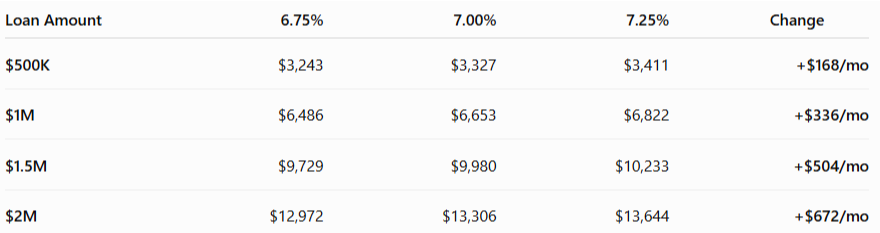
Look at the actual numbers. What does the payment look like at different rates? What price point works for you? What does your monthly budget allow? If the answer is that the payment doesn't work, then we talk about solutions. But if it does work, there’s another question worth asking:
Would you rather pay a little more in interest on a home you bought at a better price, or pay a premium for the home because you’re buying when everyone else is competing for it?
Because here’s the thing about rates:
Rates can change.
You can refinance if and when the numbers make sense in the future. When will that happen? If I knew, I wouldn't be sitting here writing a blog post. I'd be on CNBC. But the price you pay for a house is the price you pay for a house. And that's where seasonality can make a surprisingly big difference.
What Does Buying in the Fall Actually Save You?
I did a little experiment using two types of homes that a lot of my clients have been looking for this year: a 2-bedroom, 2-bath condo in Lincoln Park and a single-family home in Wilmette. I compared how far above list price buyers were paying in Q4 2025 versus Q2 2026, when the spring market was in full swing. Here's what I found:
Lincoln Park: 2-Bedroom, 2-Bath Condo
Q4 2025: 0.69% above list
Q2 2026: 7.4% above list
That's a 6.71 percentage-point difference.
Let's make that real.
If a condo is listed for $500,000, that difference works out to approximately $33,550 more in the spring market. And that's before accounting for the possibility that the actual value of the home increases between December and May.
Wilmette: Single-Family Home
Q4 2025: 1.05% above list
Q2 2026: 8% above list
That's a 6.95 percentage-point difference.
On a $1 million home, that's approximately $69,500 more.
Suddenly, the idea of shopping for a house in the fall looks a little more interesting.
And It's Not Just About the Price
When you're buying in a competitive spring market, you're often competing on much more than the purchase price.
You may find yourself:
Waiving or limiting inspection requests
Offering an appraisal gap
Making your offer significantly more aggressive
Giving up negotiating leverage
And all of those things have value.
When you're one of several buyers trying to win the same house, the seller has the leverage. When you're one of fewer buyers looking at a home that's been sitting for a little longer, you may have more of it. That's a pretty important distinction.
Does This Mean You Should Buy a House This Week?
Not necessarily.
I'm a real estate agent, but I'm also not interested in convincing someone to buy a house just because a calendar says it's a good time. The right time to buy is when the home, price, monthly payment and your personal circumstances all make sense. But if you've been thinking about buying and you've been waiting because you're worried about rates, I wouldn't automatically assume that spring will be better. In fact, the data suggests the opposite when it comes to competition, pricing and negotiating power.
The market doesn't operate in a vacuum. Rates matter. Price matters. Inventory matters. Competition matters. And, as it turns out, when you buy matters, too. So if you've been thinking about making a move, this is a pretty interesting window to get out there and see what's available.
You don't have to buy something.
You don't even have to make an offer.
But you might find that the fall market gives you something the spring market doesn't:
Options.
And options are a very nice thing to have when you're spending several hundred thousand dollars on a house.